Wednesday, September 26, 2012

Yoho National Park, Canada


Hoping to escape the rainy weather or at least get a little warmer, we travelled Trans-Canada Highway 1 to the next park, Yoho National Park.  The word Yoho is a Cree Indian expression meaning "awe."  Yoho was the first of the Canadian Rocky Mountain Parks we visited and the Cree definitely got it right.  The terrain was not vastly different from the Columbia Mountains in Revelstoke and Glacier - but wider valleys with more open views of towering rock walls, those glorious Rockies.
Kicking Horse River near Kicking Horse Campground
 
We camped at Kicking Horse Campground near the Kicking Horse River and the town of Field.  Being used to American National Parks, it was a little strange to us for there to be towns, the railway, a major highway and some development inside the boundaries of the national parks.  However since the railroad came first and was responsible for the establishment of many of the parks, it made sense that there were a few towns along the way.  The vastness of the parks and lack of development except along the railway corridor insure that the visitor can still be very remote from civilization.
Daisies on shore of Emerald Lake - very rainy day
 
Alas, we did not escape the rain or the cold but we were able to get in several hikes and some sightseeing. We drove and explored the Yoho Valley Road and took a short hike to Takakaw Falls. The next day we hiked around Emerald Lake in the rain. Then we warmed up with a nice lunch of soup and fish at the Truffle Pig Bistro in Field (an advantage to having towns in National Parks).

Takakaw Falls in Yoho Valley

Saturday, September 22, 2012

Rainy Day in Glacier National Park, Canada


Cold, rainy day in Glacier on Rock Garden Trail
 
The colder weather started almost as soon as we arrived at Glacier. Our first two days had highs in the low 50's and were mostly dry. But then the rains came and made long hikes a bit more daunting.  We had rain gear but still didn't want to be hiking in cold pouring rain all day for Maya's sake as much as our own. So after an overnight low of 37 and rain still coming down the next morning, we decided a 'camp day' was in order. 
We used the morning to cook warm, comfort food -- steel cut oats for breakfast, tomato soup and grilled cheese sandwiches for lunch and 'Chili Blanco' for dinner.  We stayed cold for most of the morning since we had not used the furnace before and had to figure out how to make it work. After a little grumbling and consulting our owner's manual, David finally got the heat going.
Our Canadian National Park Campground, like the American counterparts, had no power just water and very cold water at that.  So with no electricity for our microwave or convection oven, just two small gas burners on our stove and the gas furnace in the RV for a little heat we prepared our meals. 
Cooking several hot meals on two little gas burners in a tiny kitchen with next to zero counter space was quite challenging.  We were tripping all over each other and there were dirty dishes and food all over our 200 square feet. Until the cold weather, we cooked outdoors quite a bit and had not prepared so much food at one time. Add poor Maya as a speed bump and it was getting ugly.  (Bless her, she was trying to keep out of the way, but it just wasn't working for any of us...)
 
Rock Garden Trail in Glacier
 
Thank goodness about 2 pm the rain let up a little and we decided we could risk a short hike. We drove to the Rock Garden Trail just a few miles away and hiked through a very old rock slide that over time became covered in lichens and moss.  It truly was a ‘rock garden’ as many of the huge boulders were completely covered in moss and had almost bonsai looking trees growing on them and several types of lichens covered other rocks.  It was a bit precarious as the trail over the rocks was wet and slippery, but it was very beautiful to see this special place.  And we had hot white bean and chicken chili waiting for us back at camp.  The day ended much warmer and happier than it started.
 
'Map' Lichen on a rock


Columbia Mountain Ranger Talk


High mountain winter habitat for woodland mountain caribou
 
During our time in Glacier and Revelstoke we were able to take in a Ranger 'Campfire' program one evening.  So here is a little Ranger humor, "Do you know how to tell the difference between black bear and grizzly poop?  Black bear scat has seeds and berries in it and grizzly's smells like pepper and has little bells in it."  I love Ranger humor...  Seriously from the talk we learned more about the inland temperate rainforest and other ecosystems in the Columbia Mountains and about one of its special animals, the woodland mountain caribou.
The temperate rainforest is not the only ecosystem in the Columbia Mountains. The subalpine forest, the alpine tundra and the avalanche chutes are the three other life zones in this area, each with its own unique plants and animals. The ranger said that it might be more correct to call the Columbia Mountains a ‘snow forest.’  Annually about 50 feet of snow and 24 inches of rain fall in Revelstoke and Glacier National Parks. Most of the moisture in this rainforest comes from snow and snow melt.
Inland temperate rainforest - woodland mountain caribou habitat
 
We also learned about the woodland mountain caribou that has dwindled to only 7 animals here in these 2 parks.  This species of caribou has especially adapted to go up into the mountains in the winter rather than down into the valleys like the other species of caribou. They can eat the boxwood and other shrubs that grow in old growth forests and then as the snow covers these plants they can switch to eating lichens. They are able to ‘splay’ their large hooves and dew claws like snow shoes which allows them to walk on top of the snow to reach the lichens growing on branches. What cool survival adaptations!  But as the old growth forests diminish so does their habitat.  Much research is going on now to try to help the caribou re-establish in Glacier and Revelstoke.

Lichen, a preferred food of the caribou


Glacier National Park, Canada


Columbia Mountains near Loop Brook Campground, Glacier National Park

Loop Brook Campground in Glacier National Park was where we camped during our stay in the Columbia Mountains. The campground was located on the site where the Canadian Pacific Railroad started its 'loop' into the Columbia Mountains and eventually into the Rocky Mountains through Roger’s Pass.

We walked the interpretive trail located in the campground and learned much about how the Canadian Pacific Railroad was constructed through this challenging area. To keep the grade at the required 2.2 % for the railway, a new design was needed and tall wooden trestles were constructed that took the train through almost figure 8 loops as it climbed the pass.  Later the wood trestles were replaced by stone and steel trestles.  Many of the stone and steel trestles still stand around the campground today although the trains now go through a series of tunnels.
View of stone trestles near Loop Brook Campground
 
In order to promote the railroad and create more business for themselves, the Canadian Pacific Railroad highly promoted travel in this beautiful area of Canada.  In fact, the CPR was mostly responisible for the Columbia Mountain and Rocky Mountain parks being established.  It was interesting to hike through the forest and see the old train bed and stone trestles and imagine what an adventure it would have been to take a train through this dangerous pass during the Victorian era.


Thursday, September 20, 2012

Images of Revelstoke National Park, Canada


Wildflowers along Summit Trail in Revelstoke N. P.
 
One of the great things about Revelstoke National Park is that the one road leading into the park, called the “Meadows in the Sky Parkway,” does quite a bit of climbing. So the road did much of the work and David and I were able to take quite a long walk into the alpine because we didn't have to spend so much time and effort climbing to elevation.  

We took the Summit Trail through a subalpine forest which then connected with the Miller Lake Trail.  We still had about 595 feet elevation gain but it would have been so much more if we had to start at the bottom of the road. The two trails wound through meadows, boulder fields, above the tree line and eventually to a gorgeous alpine lake.
 
Miller Lake
 
 
The wildflowers were magnificent -- still gorgeous the first week in September.  Each turn in the trail brought a new meadow with even more gorgeous ones. I made a ton of photos but nothing does it justice, it must be experienced. And cameras can't capture the sweet smell. 


Wednesday, September 19, 2012

A Long Break...


We are back in the United States!  We had such a fantastic time in the Canadian Rockies but finding Internet proved to be harder and more effort than we feared in the remote areas we visited.  So, over the next week or so I'll make several 'Canada' entries with some of the highlights of our time there.
Our first destination was Revelstoke National Park. We crossed the border into Canada at Osoyoos, British Columbia.  The line of vehicles going through the border station took about 30 minutes and after a few questions about weapons and showing our passports and Maya’s rabies certification, we were legally in Canada.
British Columbia 97 north was our route and along the way, we passed mile after mile of cherry, apple, pear and plum orchards, vineyards and wineries and fields of corn.  Roadside fruit and vegetable stands were everywhere and we could have been legally drunk in about 30 miles (or I should say 50 kilometers),  if we stopped at every winery.  We bought pounds of fresh peaches, prune plums, apples, ripe tomatoes, cucumbers and corn. 

After staying a night in Kelowna at a commercial RV park, we drove north on BC Hwy 97 until we reached Sicamous and then we took Trans-Canadian Hwy 1 east to the town of Revelstoke and just a few kilometers from Revelstoke National Park.  We walked the quaint little town of Revelstoke and enjoyed the gorgeous flower baskets and planters in front of all the shops and the mountain peak views in every direction. It felt like an Austrian or Swiss village. 
Downtown Revelstoke

Revelstoke National Park is fairly small and has no camping facilities in the park so we drove a short way over to Glacier National Park to camp. Over the next several days we hiked and explored both parks. Both of these parks are not officially in the Rocky Mountains, but the Columbia Mountains.  The Columbia Mountains are the only inland temperate rain forest in the world.  All the other temperate rain forests in Northern California, Oregon, Washington, Canada and Alaska are on the coast.  So this area and these two parks are quite unique.

Giant Cedar Boardwalk Trail in Revelstoke National Park

Wednesday, September 5, 2012

Oh, Canada!

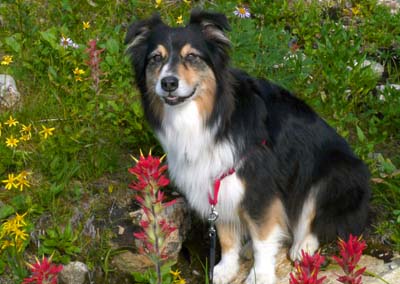
Indian Paintbrush in high alpine meadow in Mt. Revelstoke National Park, Canada


We are in Canada and have limited access to Internet.  Look forward to hearing from us in a week or two at the most.  We've already had a dusting of snow one morning.  I don't think the wildflowers will last much longer in the alpine meadows but they have been gorgeous.  Stay tuned...