Thursday, March 14, 2013

Spring Break


Wild violets - another early sign of spring

Sequestration may be upon us but things seem to be working well so far in the Texas State Parks.  However it is a good thing we made some reservations!  The last few days have been the most crowded camping we have seen in any parks since we started our adventure 10 months ago.  Maybe the college set goes to the beach for spring break but families with small children go camping. 


A rare sight - a parked bike during daylight hours 

Forget the convertibles and sports cars, tricycles and bicycles with training wheels are the preferred mode of transportation here in the parks and they race by at all hours of the day.  But the good news is that by sundown the bikes circle at the fires of their respective campsites and the young riders head to bed early. 

Once the sun is down, it is time for Maya’s stroll through the campground.  We have been enjoying this ritual lately.  I don’t know if it is the cold nights that have kept the humidity low or that the moon is ‘new’ but the night skies and stars have been awesome – really.

Spain built the first mission in the province of Texas.
The Civilian Conservation Corp built a 'Mission Replica' in Mission Tejas State Park.
 

 Last night, at Mission Tejas State Park, it was so dark that Maya and I missed our turn and got a little lost.  The tall pines kept the ground very dark though the stars did twinkle through.  We could see the campfires in the distance and made our way back but we never did find the path.  (Note to self: don’t forget to put the flashlight in your pocket.)  Being with Maya made me feel braver but  I did think how fragile we are and how any one of us alone or even with a dog, is not very fit for survival anymore.  We were so small and the night felt so overwhelmingly infinite.  I think Maya felt it too.  She walked very hesitantly, stopping frequently as we made our way back towards the fires.  But it could have been that her nose and ears were telling her much more about the night than I could ever know. 


The only place that is open to the public to walk on 'The King's Highway.'

Part of the original ‘El Camino Real’ or the King’s Highway that ran from Mexico to San Antonio on to Nacogdoches and up through Louisiana, is located in Mission Tejas State Park.  You can walk in the original traces of this ancient road used by famous Texans such as Stephen F. Austin, Jim Bowie, Sam Houston, Davy Crockett and many others.  I bet they had better sense than to wander off from camp at night without their ‘light.’


Redbuds blooming in Mission Tejas State Park


Thursday, March 7, 2013

Signs of Spring


Texas Mountain Laurel blooming near San Marcos


Much as it usually does, March came in like a lion.  The winds blew in during the last night of our stay in Ft. Davis.  The RV was a ‘rockin,’ but it wasn’t due to anything we were up to…  It felt like we were out on the high seas.  Maya didn’t like it much and towards morning she was up on the bed with us cuddled as close to our heads as she could get. 
The morning came with no signs of the wind letting up. We had second thoughts but decided to head on anyway and ‘sailed’ in to Odessa with a strong wind on the starboard quarter.  We had a nice four day weekend with my family and then ‘sailed’ on to San Antonio as the wind seemed determined to blow on any day we wanted to drive.  But that is just March in West Texas.  I remember well my many windy West Texas springs.
 
Redbud at South Llano River State Park


Agarita at Guadalupe River State Park
 
The wind did not limit itself to West Texas.  It blew as hard as I have ever seen it in San Antonio on our first day back – with gusts up to 40 – 50 mph.   Thank goodness it gave us a break the following day.  Wind can really wear you down…
We spent nights in South Llano River State Park, Guadalupe River State Park, on friends’ land near San Marcos and at Palmetto State Park.  Spring was quickly bursting on the scene at all of these places.  One of the first signs of spring in South Texas, the mountain laurel, was near the end of its blooming in San Antonio but still going strong near San Marcos.  Redbuds too, were in full bloom and there should be a bumper crop of Agarita berries if the blooms are any indication.
 
"Nature's first green is gold
Its hardest hue to hold..."


I love seeing the first waves of green as the trees and shrubs are getting their new leaves and the grasses are just coming up.  It always reminds me of that Robert Frost poem, “Nothing Gold Can Stay.” 
The Carolina Buckeye is also one of those early indicators of spring and we saw the small tree just starting to leaf out at Guadalupe River State Park but a week later in Palmetto State Park the buckeyes were in full bloom.  What a difference a week and 60 miles can make.  
 
Red Buckeye or Carolina Buckeye at Palmetto State Park
 
Buckeye and Giant Swallow Tail Butterfly
 
 
We plan to spend the next couple of weeks visiting friends and seeing spring in South and East Texas.  This April it will be a year since we bought our RV and we have to go to the Dallas area for the one-year check up. So we will make our way east and then north visiting as many state parks as we can work in and trying to avoid the spring break crowds (which may prove challenging).
It won't be that much longer before we head east for new adventures.  This year we are going to head across the south and then follow the Appalachian Trail (more or less) up the east coast to Maine and perhaps on into Canada.  We've never travelled much on the east coast, just to some of the bigger cities, Boston, D.C. and N.Y.C.  If you have suggestions for us, let us know - a favorite place or trail, restaurant or historic site, we will try to work it in.  It is all new to us and we want to see as much as we can. 
 
Texas Baby Blue-eyes at Palmetto State Park


Wednesday, February 20, 2013

West Texas Mountains


Elephant Tusk Mountain from Skyline Trail


The snow in Ruidoso was great fun, but we were ready to come back to Texas winter weather.  Ft. Davis was our next destination.  When we arrived back in Texas last November after our western journey, Davis Mountain State Park had been our first stop. This partly mountainous, partly Chihuahuan Desert region of Texas so near where we grew up still calls to us.  Its space, beauty and stars are etched in our souls.  And so we return often…
 
Linda, Tim, Maya and David on the Skyline Trail
 
My brother Tim and his wife Linda joined us for a couple of days.  We met them after Christmas at Galveston Island State Park but cut our time short because of the high winds and rain there.  So we decided to give it another chance in another place.  This time the weather was fabulous with 60 degree days, 30 degree nights – perfect hiking and camping weather.
 
Maya on top of the world...
 
From the tops of the mountains, the views are fantastic.  The Davis Mountains rise 5,000 feet from the desert floor creating a chain of ‘sky islands’ separated by an ocean of desert.  The air is clear and it seems you can see forever, like being on top of the world.
 
Elephant Tusk from South Primitive Trail
 
David and I hiked a new area for us, the primitive section of Davis Mountain State Park.  It was a bit overcast and there were a few sprinkles, but otherwise it was another fine day in the mountains.  The view of Elephant Tusk Mountain was outstanding from the top of the South Primitive Trail.  We had a grand time and really worked out our legs climbing up those mountains.  We’ve been a bit lazy since Christmas…
 
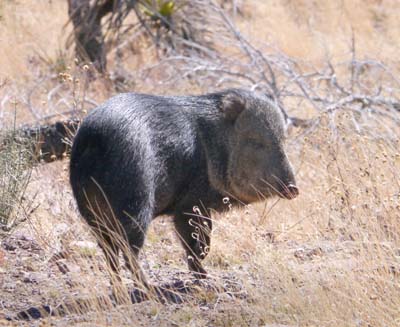
Javalina, a  new world pig and native of West Texas
 
Prickly Pear is a favorite food of Javalina as evidenced here
 
Agave or Century Plant - whole prehistoric cultures depended 
on the agaves for survival
 
Waves of grass
Grasslands are still abundant in the Davis Mountains


Monday, February 18, 2013

Snow on the Mountains!


View of Sierra Blanca from Ruidoso

Snow fell during the early morning hours on our last day in Ruidoso.  We arose to about 2 inches of a powdery, sparkly frosting of snow on everything.  The ski area and the surrounding White Mountain Wilderness received 6 – 8 inches.  Like kids out of school on a ‘snow day’ we hurriedly dressed and went out to play.  Maya thinks snow is just about the most fun thing there is so she was off running, barking and burying her head up to her ears in the soft, wet stuff.  David and I were almost as bad.

Snow frosted pines from the deck of my parent's cabin

We went out to breakfast with Jim before he headed back to Ft. Worth.  It was kind of scary creeping and sliding down the steep road from my parent’s cabin into town but we were determined to make it to the Cornerstone Bakery.  They have the best pinon coffee we have ever tasted and their breakfast selection of New Mexico egg dishes, pancakes and pastries is quite good.


Santa Fe Eggs Benedict


Cornerstone Bakery Breakfast


Jim got off safely for his trip home but we couldn’t get our car back up the road to the cabin.  No worries, we hadn’t had our fill of the snow yet, so we went for a long walk and played with Maya until the road was plowed and the snow had melted off a little more. The sun was quickly warming things up and the snow would not last long in town.  We finally arrived back at the cabin cold and wet.  Maya’s fur had frozen in places, so we had a little warming up and drying off to do, but it was a great way to spend our last day in the mountains.  We were happy to hear that more snow was predicted in the days to come.  Maybe the rest of February will bring much needed moisture to the mountains.

Snow Maya

Monday, February 11, 2013

Six more weeks of winter and Ruidoso, NM


Well, shadows were seen by the various official weather predicting groundhogs and the verdict came back – six more weeks of winter.  I’m not sure that Texas, especially south Texas follows the same rules.  Perhaps we need our own special spring predicting animal, maybe the armadillo?
 
Light snow cover in the White Mountain Wilderness
 
Anyhow, in the spirit of experiencing a little more winter, David and I went out to Odessa to visit family for a week and then up to my parent’s cabin in Ruidoso, New Mexico.  David’s brother, Jim, drove down from Ft. Worth to join us. 
Ruidoso has been a special place for David and I since we were first married and we have spent many a vacation in the cool mountains to escape the San Antonio summer heat.  Right before beginning our RV journey back in June 2012 we spent a week in Ruidoso hiking and enjoying the mountains. 

As it turned out, we were so glad we made that trip.  A week later a lightning strike started a fire in the nearby White Mountain Wilderness that quickly got out of control.  The Ruidoso/Little Bear Fire continued to burn for two more months and before the fire was out 44,330 acres of our beloved forest were badly burned.  Fortunately, the town of Ruidoso and much of the surrounding forest were spared.


Burn area about midway up ski run road

Near top of road ski run road

The first thing we noticed upon arriving in town was just how little snow was on the mountains.  Usually by February there is a decent snow pack at the higher elevations although snow falls have been trending downward in recent years.  Recovery from the fire will be more difficult unless there is more snow very soon or a wet summer.

As much as we dreaded it, we felt we had to take a drive and some short walks into the forest to see what remained.  We found that most of the White Mountain Wilderness had some fire damage.  From the ski area looking west and north, it was devastating.  The mountain tops were completely burned as far as we could see - though there were a few patches of green in the valleys and in small places here and there.


Burned peaks as far as you can see...


The more we drove and stopped and looked and walked, the sadder we became.  Fire is part of nature’s plan but we still mourn the loss of those beautiful old-growth firs, spruce and pines.  It will take a couple of hundred years before there will be old-growth stands in the White Mountains again.


But along with the devastation, signs of recovery were already showing.  On a section of the Crest Trail we saw cinquefoil and lupine growing low and close to the ground.  The clump grasses and bear grass, though dormant now, were alive and ready to start growing in the spring.  I am sure many seeds are ‘banked’ in the ground and ready to grow with warmth and moisture.

Near the end of our sad excursion into the forest we arrived at the Argentina/Bonito Trailhead, one of our favorite places to hike.  What a joyful sight it was to see that part of the valley and trailhead almost untouched by fire.  Tears were in our eyes.  The trails in this valley head up into the high country where some of the most severe fire damage occured and the forest service has put up caution signs warning hikers to expect downed trees and trail damage. So not everything escaped the fire.  But it was such a relief to see that at least a few of our ‘sacred’ places had not been completely burned away…

A bright spot - No fire here! 

Wednesday, February 6, 2013

Choke Canyon State Park and back to San Antonio

Late afternoon on the Bird Trail at Choke Canyon

After almost three weeks of hanging out and birding on the Texas Coast, we had to get back for some appointments in San Antonio.  On our way back we spent a night at Choke Canyon State Park on the shores of Choke Canyon Reservoir.  The park has a campground on the reservoir and a nice trail system consisting of at least four birding trails which we made it our mission to explore.  Each of the birding trails contain slightly different habitat and you are very likely to see hawks in "Hawk Alley," warblers on "Warbler Way," etc.   Around the reservoir there are many species of ducks and other water fowl and many migrating birds stop over in the park or winter there.  


Cypress root 'Creature' along the Guadalupe River
 
The next morning we left Choke Canyon and made a slight detour to have lunch with our friend Jose on his farm near Charlotte and to see his two new horses.  Jose treated us to steaks cooked over an open fire with all the trimmings.   Very full and happy we said goodbye to Jose and the horses,  climbed back into the RV and headed to San Antonio to stay at Guadalupe River State Park again.  
For the next several days we divided our time between the city, taking care of business and seeing friends and the park, exploring and taking long walks.  You might think we would be bored of Guadalupe River State Park by now, but in nature there is always something new to see or something you just overlooked. 

In the overlooked category, David and I discovered the Leaf Cutter Ant Colony near the river that (I can’t believe) we had not noticed before.  GRSP has a good sized colony of these ants which in garden, landscape or agricultural settings can be quite destructive.  But at the park, this colony is respected and used as an educational opportunity. 
 
Leaf Cutter Ant Mound
 
The ants go marching...
 
Don't get too close, they do bite!
 

The colonies can be quite large – 50 to 80 feet across and up to 2 million or more ants.  Leaf Cutter Ants do not eat the leaf fragments that they ‘harvest’ but take them underground to the nest where they use the material to raise a fungus garden.  As the fungus grows, certain portions are eaten by the ants and some is fed to the developing larvae.  The fungus is the only known source of food for the ants.  We spent a good chunk of time following the ants on their trails from the mounds, across the field to the trees and vines where they gathered the leaves and then back to the mounds.  Perhaps we are easily amused, but it was very entertaining.  


Entering the Discovery Center
 
Tessa and Kellen examining a fox skin
 
The next day our friends Sasha and Casey arrived with their children and of course we had to show the ants to them.  We also checked out the new Nature Center and that was very cool even if you are not a kid.  Tessa led us for a hike along the Guadalupe River and Kellen entertained us by leaping rock to rock in the river which was pretty amazing to watch.  A picnic by the river and a little more hiking and soon it was time for us all to go. Sasha and her family had things to do to get ready for school and work on Monday and we had dinner plans in San Antonio. We met David’s ex co-worker, also named David and his wife Sharon at, yes, you guessed it – Chuy’s.  What a great day!  Walk, learn something new, play with friends, eat good food and sleep – that's the way we like it...


Kellen is going to be a rock climber

 
In the middle of the Guadalupe


Picnic time

This leg of our journey might have been a little heavy on the ‘eat good food’ part.  We also met friends Cindy and John in Gruene at the Grist Mill one night and Bill and Candace in Boerne at the Creek Restaurant.  Then we visited Bill's ranch to check out the recently completed tree work on the new addition to his property. We were delighted to see about 30 male turkeys making their way through the trees on the ranch.  As we were leaving we noticed that the Great Blue Herons were beginning to stake out their nests along Cibolo Creek reminding us that our winter in Texas will soon be turning to spring.


Tuesday, February 5, 2013

Mustang Island State Park and Kingsville


Caspian Terns on Mustang Island State Park Beach


A few weeks back we scheduled a birding ‘date’ in the Kingsville area with friends Thea, Jess, Thea’s son Will and his girlfriend Holly. The nearest state park was Mustang Island, another place we had always wanted to stay, so we headed for Mustang Island to camp for the weekend and meet the gang in Kingsville on Sunday for our big birding day.

Mustang Island State Park allows primitive camping right out on the beach or there are campsites with water and electricity just behind the dunes very near the beach.  Being so close to the ocean, the campsites are out in the open, close together and exposed to the elements.  But the weather was perfect, not too windy and so our stay was lovely.  It was so relaxing to take long walks on the beach and to be gently whispered to sleep by the sound of the waves.
 
Terns in Flight
 
Early Sunday morning we drove about 35 miles to Kingsville.  Thea had worked hard to plan a fantastic day for us all.  First we had breakfast in Kingsville, then hopped in the cars for a day long adventure.  Will knew the area well as he graduated from Texas A&M Kingsville with a degree in Wildlife Management.  So, he was a natural for our tour and bird guide.  We visited 4 main habitat areas – woodland, prairie, lake and sea shore and we were rewarded with lots of great bird sightings from green jays to hawks to the white morph of the reddish egret.

After birding all morning we had a nice stop for lunch at a seafood place near the small town of Riviera.  Riviera, located on Baffin Bay, has an interesting history.  The land surrounding the bay was purchased from the King Ranch Family by a German immigrant.  He planned on turning the area into the ‘Texas Rivera.’  Several nice hotels, restaurants and other tourist facilities were built and tourists started to come.  But then World War I broke out and everything changed.  Sentiments towards Germans were not exactly friendly anymore and the government imposed many restrictions on German businesses, so the resort suffered economically and eventually failed.  Today a few marinas and restaurants are all that is left of the ‘Texas Riviera’ on Baffin Bay.
 
Great Blue Heron 'waterskiing...'
 
The afternoon consisted of more birding and exploring the Kingsville area.  We capped it all off with a great BBQ dinner and lots of talk.  Needless to say, it was late when we got back to our campsite on Mustang Island.  Maya insisted upon a moonlight walk on the beach. She had spent a good deal of the day in the car or waiting on us while we scanned sky and shore for birds.  Maya doesn’t quite understand how we can spend so much time just standing in one place looking.  Smelling is so much more rewarding.